
How e�ective is CPCB in its management of e-waste?

The world produced around 53.6 million tonnes of e-waste in 2019, out of
which only 17.4% was recycled.
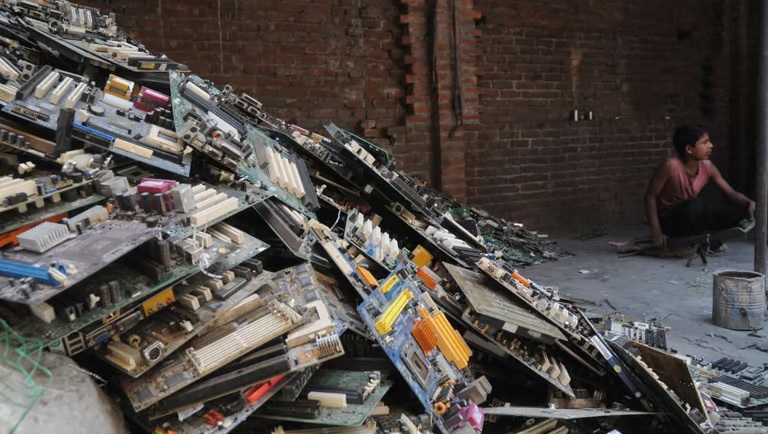
Electronic waste (e-waste) is the fastest-growing stream of waste globally.
The world produced around 53.6 million tonnes of e-waste in 2019, out of which only
17.4 per cent was recycled, a recent report by the United Nations (2020) found. The
agency even termed this phenomenon a ‘tsunami of e-waste’.
The global e-waste monitor reported that India, with a population of around 1.38
billion, generated 3,230 kilotonnes (KT) of e-waste, out of which only 30 KT of e-waste
was formally collected in 2019.
India generated around 2.4 kilograms of e-waste per capita; only 1 per cent of e-waste
was formally collected. The informal sector of waste collection dominates over the
formal sector, which is still in its infancy.
It should be noted here that while India’s per-capita generation is among the lowest in
the world, the country is the third-largest generator of e-waste in the world.
The facts are disturbing. The responsibility of managing e-waste in India lies with the
Central Pollution Control Board (CPCB) and State Pollution Control Boards (SPCB).
The authorities were recently summoned by the principal bench of National GreenTribunal (NGT), when the latter took cognizance of unscienti�c disposal of e-waste in
Shailesh Singh v. State of UP.
The NGT asked the authorities to submit a report on the actions taken to manage the
e-waste in and around the capital.
Important data on e-waste
The number of producers having extended producer responsibility
authorisation (EPRA) as on November 26, 2020 was 1, 630; it was 1,703 on
March 26, 2021. There was an increase of 73 EPRAs in one quarter
The number of registered producer responsibility organisations (PRO) on
November 26, 2020, was 44 and 51 on March 26, 2021 — an increase of seven
PROs in one quarter
The number of authorised dismantlers / recyclers was 312 on November 26,
2020, and 400 on March 26, 2021 — an increase of 88 authorised dismantlers /
recyclers in a quarter
The authorised recyclers and dismantlers had a combined processing capacity
of 782,080.62 tonnes per annum on November 26, 2020; it was 1,068,542.72
tonnes per annum on March 26, 2021 — an increase of 286,462 tonnes per
annum in a quarter
The quantity of e-waste dismantled and recycled during FY 2017-18 and FY
2018-19 was 69,413 tonnes and 164,663 tonnes respectively — an increase of
95,250 tonnes in one year
The collection target for FY 2017-18 & FY 2018-19 was 35,422.25 tonnes and
154,242.74 tonnes respectively. E-Waste collected against the collection
target during FY 2017-18 and FY 2018-19 was 25,325.28 tonnes and
78,280.99 tonnes respectively
A few states still have the lowest numbers of authorised recyclers /
dismantlers: Assam (1), Chhattisgarh (2), Himachal Pradesh (2), Jharkhand (2),
Madhya Pradesh (2), etc
The states with the highest number of authorised recyclers / dismantlers are
Maharashtra (99), Karnataka (71) and Uttar Pradesh (68). A few states — such as like
Arunachal Pradesh, Bihar, Kerala, Manipur, Meghalaya, Nagaland, Sikkim, etc — are
yet to establish them.
Action by CPCB so far
CPCB for the �rst time quanti�ed the generated e-waste in past three FYs: For 2017-
18: 708,445 tonnes; for 2018-19, 771,215 tonnes; and for 2019-20, 1,014,961.2
tonnes.
It directed the Uttar Pradesh PCB to take action against dismantlers and recyclers for
violating e-waste rules and guidelines.
t recommended the inclusion of 75 new entries of electronic equipment to the
existing list of 21 entries in schedule 1 of the e-Waste Rules
It prepared guidelines for Environmental Compensation Charges (ECC)
It issued show-cause notices to 186 producers for not meeting the collection
targets
CPCB issued show-cause notices to 292 producers whose collection centers
were found non-complying or non-traceable
It issued show-cause notice to 523 producers on October 6, 2020, for not
submitting their annual returns
A review meeting with all SPCBs / PCCs via video conference was organised to
review the status of the implementation of the action plan during the �rst and
second quarters of FY 2020-21
It also organised a two-day training program on the E-waste Management
Portal for SPCB / PCC of�cials
It regularly asks the SPCBs / PCCs to revise the capacity of dismantlers and
recyclers
Shortcomings in e-waste management
Producers of the noti�ed 21 categories of electronic equipment are not able to
collect e-waste as per the speci�ed target
Only a few producers have been granted EPRA from CPCB. Only 1,630
producers have EPRA
Many unauthorised dismantling and recycling units are still in function
Ef�cient monitoring of the authorised dismantlers / recyclers is required due to
the leakage from authorised to unauthorised dismantlers and recyclers
Authorised dismantlers and recyclers have been given processing capacity
beyond their actual processing capacity by the SPCBs
Ensure allocation of industrial space or shed for e-waste dismantling and
recycling in the existing and upcoming industrial parks and clusters
The generation data collected by CPCB is based on the sales data of producers
registered with it. They do not include imported e-waste �gures. Therefore,
actual �gures for e-waste generation are likely to be far higher than the current
estimates
A national-level inventory of e-waste generation should be prepared. State-
wise data is not produced due to a lack of reported data by SPCBs
What can be done?
Strict enforcement of the existing domestic rules and regulations
An integration model for the informal as well as the formal sector will result in
lower costs at the pre-processing stage and ef�cient recycling
Data inventory for data analysis and interpretation to know an estimate of e-
waste produced annually.