Central pollution watchdog recommends fines up to �1 lakh forillegal extraction of groundwater

In a report to the NGT, CPCB has recommended levying fines ranging from �10,000 to �1 lakh for illegal
extraction of groundwater at a time when India is facing an unprecedented water crisis.
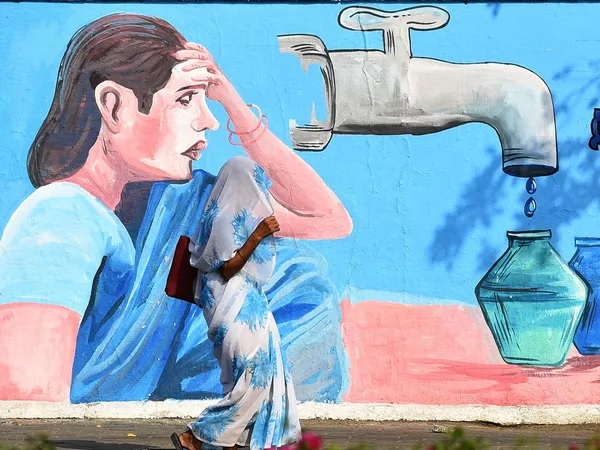
New Delhi: At a time when India is staring at an unprecedented water crisis, the Central Pollution Control Board is
pushing for the imposition of fines on citizens caught illegally extracting groundwater. For this purpose, CPCB has
suggested environmental compensation (EC) ranging from �10,000 to �1,00,000. The focus of this measure will
be Delhi and the surrounding national capital region (NCR).
The suggestion was made by a panel of CPCB officials in a report they submitted to India’s top green court,
National Green Tribunal. In its report, the panel stated that environmental compensation charges in case of
domestic or household uses can be kept low. However, it recommended higher rates for groundwater extraction for
institutional, commercial, infrastructural and industrial purposes.
Fines to be levied on offenders will be calculated by multiplying the consumption per day with EC, the number of
days and deterrent factor. The range of the fines is being pegged at �10,000 for households, �50,000 for
commercial complexes and townships up to �1 lakh for industrial activity. The panel also recommended
categorising areas into safe, semi-critical, critical and over-employed on the basis of groundwater resource
estimates by the Central Ground Water Board (CGWB).
Titled ‘Assessment of Environmental Compensation in Case of Illegal Extraction of Ground Water’, the report was
submitted in compliance with NGT’s order of May 7 in a case filed by Delhi-based environmentalist Shailesh Singh
against industries in Noida and Greater Noida. The report further mentioned that the falling water table is a matter
of special concern since it tends to “reduce the accessibility of the resource to small and marginal farmers due to
increase in costs of extraction”.
Also Read: NGT slams MoEF over failure to submit report on policy for groundwater conservation
The CPCB panel further recommended that the “violation duration” should be assumed as being at least one year
in cases where no evidence of the date of borewell extraction could be ascertained. Meanwhile, water
consumption in cases of industrial groundwater abstraction should be estimated on the basis of consent conditions
imposed by the respective state pollution control board or the pollution control committee of that particular state.
Groundwater constitutes the main source of drinking water for Indians. The per capita water availability was 5,177
cubic metres in 1951 as compared to 1,545 cubic metres in 2011. This drastic decline of about 70 per cent in 60
years essays the groundwater consumption trend in India and the immediate need to take stock of the condition.
The central government’s Jal Shakti Abhiyan is also a massive move to attain the objective at hand.